Health Frequency (Ħ) and Its Biological Interactions
Living organisms are complex systems that interact with their environment through various physical and chemical processes. Among these interactions, the role of waves—electromagnetic, acoustic, and quantum—has gained increasing attention. Health Frequency (Ħ) are mathematical models that describe how waves interact with biological systems, influencing cellular and systemic responses. These waves can be categorized based on their effects: healing (beneficial), favorable (neutral or mildly positive), destructive (harmful), and lethal (severely harmful).
Health Frequency (Ħ) represents a novel mathematical framework for understanding the mechanisms of interaction between environmental waves and biological systems, with the logistic opportunity to take care of and control the behaviors of our health. This dissertation explores the theoretical foundations of wave interactions as a mathematical model for the experimental validation of Ħ. It categorizes them into healing, favorable, destructive, and lethal based on their wave effects on living organisms. By integrating quantum mechanics, electromagnetic theory, and cellular biology, this work provides a comprehensive model for how waves influence biological systems and proposes a robust experimental framework for validation. The findings have significant implications for medical science, material design, and environmental health.
The Equation of Biological Coherence
(Amplitude and phase of the body structures define the stability of life's inner rhythm)
Ħ(x,t) = A(x,t)·e^(iφ(x,t))
Or Ħ = A·e^(iφ)
Where:
A(x,t) is the amplitude function at position x and time t - tells us the strength of the wave
φ(x,t) is the phase function - tells us about its timing or alignment
i is the unit
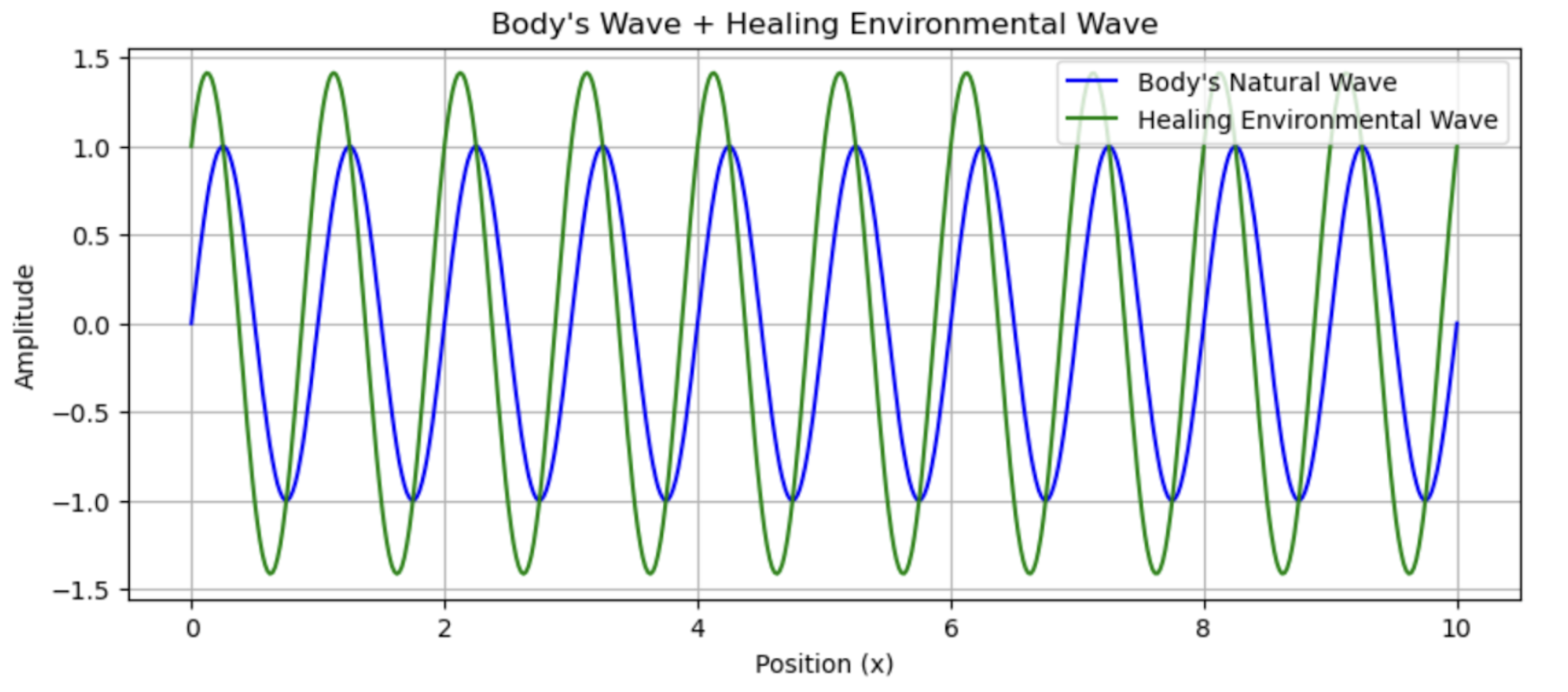
Category 1 (Healing wave):
Ħ₁(x,t) = B(x,t) + E(x,t) + k₁·B(x,t)·E(x,t) + R₁(x,t)·cos(θB - θE)
Or Ħ₁ = B+ E + k₁·B·E + R₁·cos(θB - θE)
Where:
B(x,t) is the body's natural wave function
E(x,t) is the environmental wave function
k₁ is the positive resonance coupling constant (>1) which amplifies the effect
R₁ is the resonant amplification function
θB and θE are the phase angles of body and environmental waves
The cosine term creates maximum amplification when waves are in phase
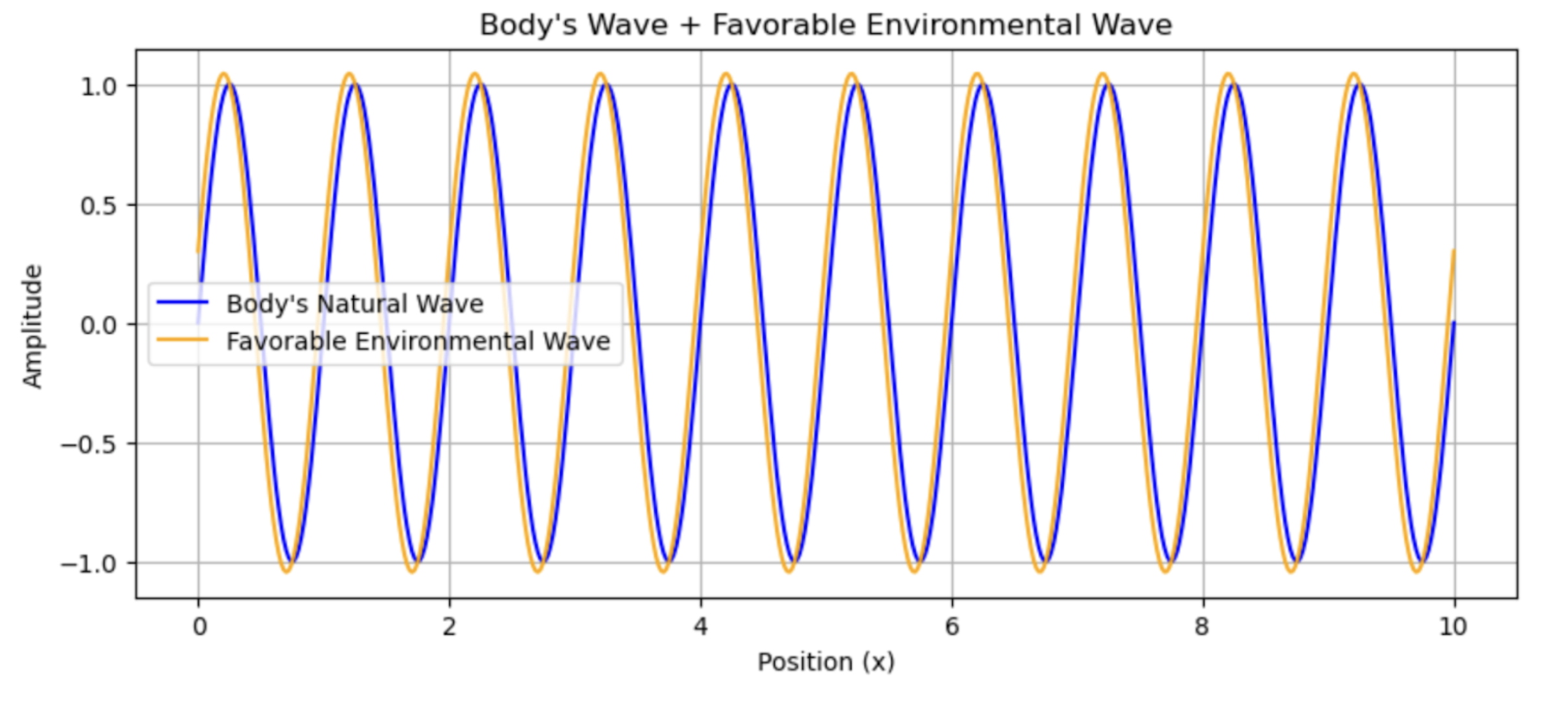
Category 2 (Favorable wave):
Ħ₂(x,t) = B(x,t) + E(x,t) + k₂·min(B(x,t),E(x,t)) + R₂(x,t)·|cos(θB - θE)|
Or Ħ₂ = B + E + k₂·min(B,E) + R₂·|cos(θB - θE)|
Where:
k₂ is a moderate positive coupling constant (0
R₂ is a smaller resonant function than R₁
|cos(θB - θE)| The absolute value ensures only constructive interference occurs
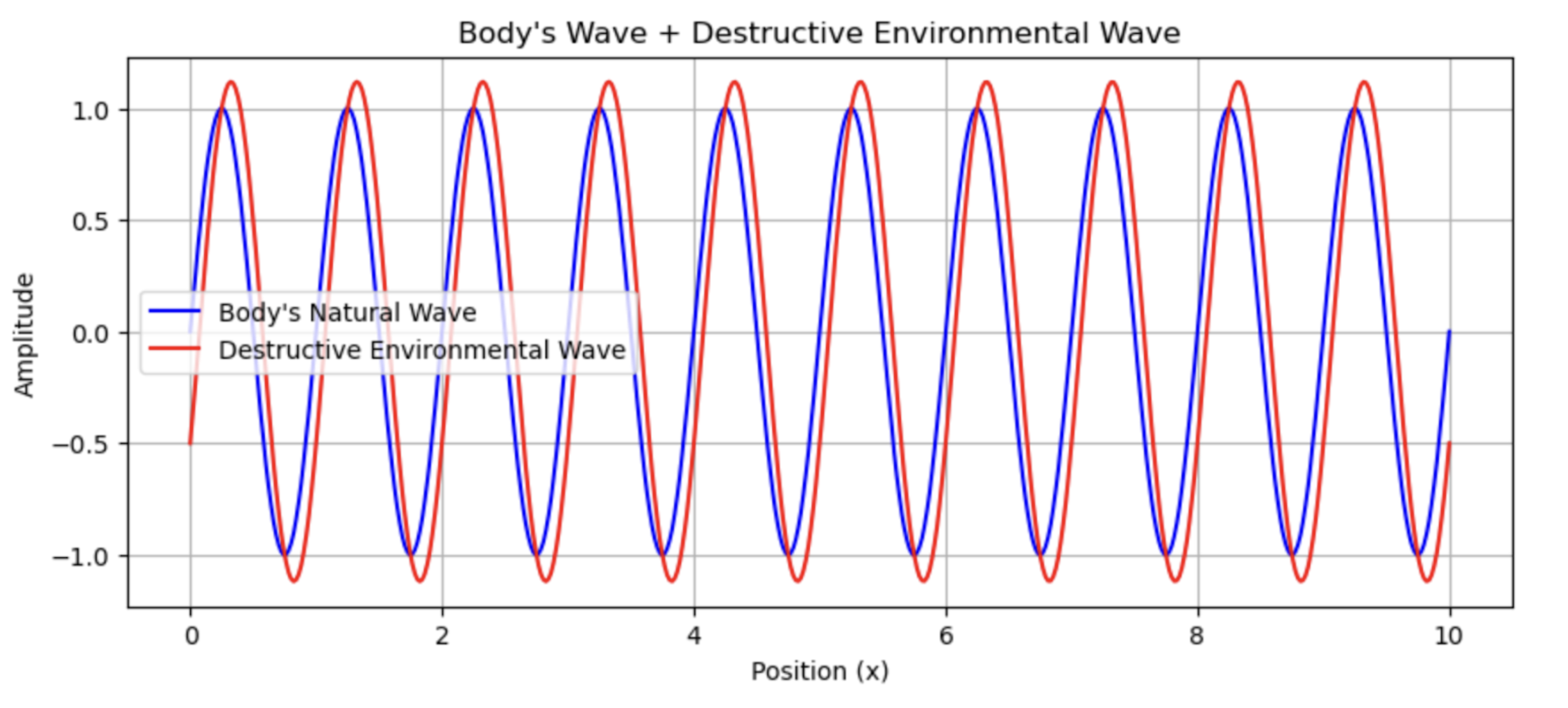
Category 3 (Destructive wave):
Ħ₃(x,t) = B(x,t) - |α·E(x,t)| + k₃·B(x,t)·E(x,t) + D₁(x,t)·cos(θB - θE + π)
Or Ħ₃ = B - |α·E| + k₃·B·E + D₁·cos(θB - θE + π)
Where:
α is an attenuation coefficient (0<α<1)
k₃ is a negative coupling constant (-1
D₁ is a destructive interference function
The phase shift of π ensures waves are out of phase
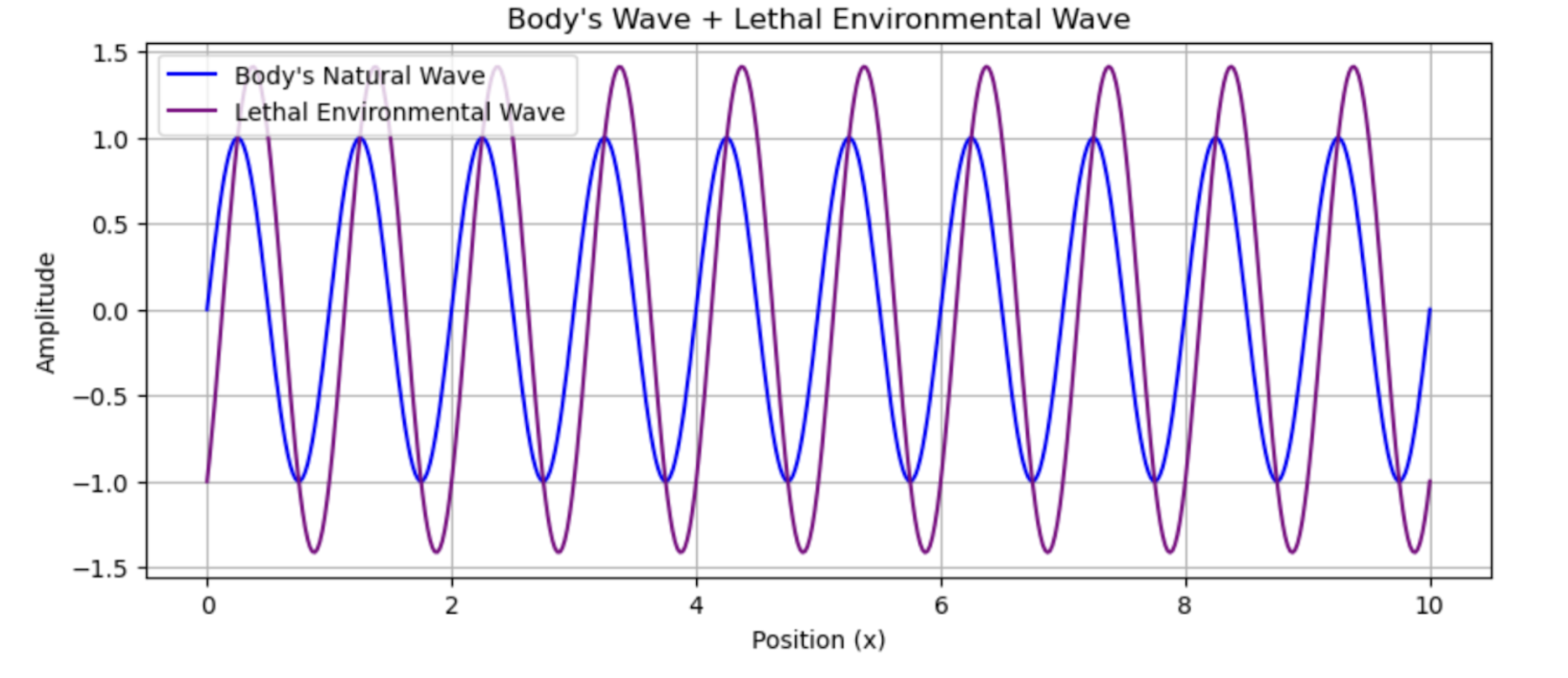
Category 4 (Lethal wave):
Ħ₄(x,t) = B(x,t) - β·E(x,t) + k₄·B(x,t)·E(x,t) + D₂(x,t)·cos(θB - θE + π)·e^γt
Or Ħ₄ = B - β·E + k₄·B·E+ D₂·cos(θB - θE + π)·e^γt
Where:
β is an amplification coefficient for destructive effects (β>1)
k₄ is a strongly negative coupling constant (k₄<-1)
D₂ is a stronger destructive function than D₁
γ is a time-dependent amplification constant